
WRITING
The European Accessibility Act covers your app, not just your website
12 min read
If your app lets consumers in the EU buy something, bank, read e-books, book passenger transport, use an electronic communications service or reach audiovisual media, the European Accessibility Act has applied to it since 28 June 2025. The law names mobile applications in its own text. Many teams treated the Act as a website project, and that reading does not survive contact with Directive (EU) 2019/882.
This post reads public primary sources as of November 2026. It is not legal advice.
The Directive names mobile apps in its scope, so the app is not a side channel
Article 2(2) lists the services the Directive covers when they are "provided to consumers after 28 June 2025":
- electronic communications services
- services providing access to audiovisual media services
- certain elements of air, bus, rail and waterborne passenger transport services
- consumer banking services
- e-books and dedicated software
- e-commerce services
Article 3(30) defines e-commerce services as "services provided at a distance, through websites and mobile device-based services by electronic means". The passenger transport elements include "mobile device-based services including mobile applications", and the e-book definition in Article 3(41) does the same.
Where the company sits does not decide the question. Article 3(4) defines a service provider as "any natural or legal person who provides a service on the Union market or makes offers to provide such a service to consumers in the Union." A team outside the EU whose app sells to EU consumers is in the same position as one in Berlin.
Annex I asks service providers to make "websites, including the related online applications, and mobile device-based services, including mobile applications, accessible in a consistent and adequate way by making them perceivable, operable, understandable and robust". Those four words are the principles behind WCAG. As we argued in web app vs mobile app in 2026, platform choice changes how you do the work, not whether you do it.
Article 2(4) excludes a few things, including "third-party content that is neither funded, developed by, or under the control of, the economic operator concerned". That test turns on funding, development and control, so an SDK screen or user upload is not exempt just because someone else made it.
Microenterprises providing services are exempt, and almost nobody else gets a blanket pass
Article 4(5) says "Microenterprises providing services shall be exempt from complying with the accessibility requirements". Article 3(23) defines a microenterprise as one that "employs fewer than 10 persons and which has an annual turnover not exceeding EUR 2 million or an annual balance sheet total not exceeding EUR 2 million." Where a firm has partner or linked enterprises, some of their staff and financial figures may count too, depending on the relationship; the Commission's SME guidance says a firm in a larger group "may need to include staff headcount/turnover/balance sheet data from that group too."
Everyone else gets relief case by case at most. Article 14 says the requirements apply only to the extent that compliance does not cause a "fundamental alteration" of the service or impose a "disproportionate burden". That route comes with paperwork. The assessment has to be documented and its relevant results kept for five years after the service was last provided. A service provider relying on disproportionate burden must renew it when the service changes, when the authority asks, and at least every five years. Anyone relying on either ground must inform the authority, except microenterprises. Recital 66 adds: "Lack of priority, time or knowledge should not be considered to be legitimate reasons."
The transition rule in Article 32 is often misread. It gives "a transitional period ending on 28 June 2030 during which service providers may continue to provide their services using products which were lawfully used by them to provide similar services before that date", and lets service contracts agreed before 28 June 2025 run on for up to five years. Our reading is that this covers equipment such as existing terminals and old contracts. It is not a general grace period for apps or an extension of the 2025 application date.
The Directive never names WCAG, so EN 301 549 is the bridge, and its citation is still pending
Article 15 gives a presumption of conformity to products and services that meet "harmonised standards or parts thereof the references of which have been published in the Official Journal of the European Union". The standard being prepared for this role is EN 301 549.
Version 3.2.1, from 2021, is built on WCAG 2.1 AA and is the reference for the public sector Web Accessibility Directive. Version 4.1.1 was published on 2 September 2026. According to a clause-by-clause review of the ETSI text, it brings in six WCAG 2.2 criteria: Focus Not Obscured (Minimum), Dragging Movements, Target Size (Minimum), Consistent Help, Redundant Entry and Accessible Authentication (Minimum).
As of 3 November 2026, no edition was cited under the Accessibility Act. A citation tracker updated on 17 October records the standard as delivered to the Commission on 23 September, and says ETSI's project schedule targets 16 December 2026 for citation, while "the Commission has published no date." The 30 November 2026 date that appears in the standard is an announcement date for national standards bodies, not a citation. Until it is cited, version 4.1.1 gives no presumption of conformity under Article 15.
In practice, we would build to WCAG 2.2 AA, as an engineering target rather than a confirmed legal baseline, because that is where the presumption is heading, and check the Official Journal before you state which standard you meet. Whichever version is cited, the standard does not write your Annex V information for you. That stays your job.
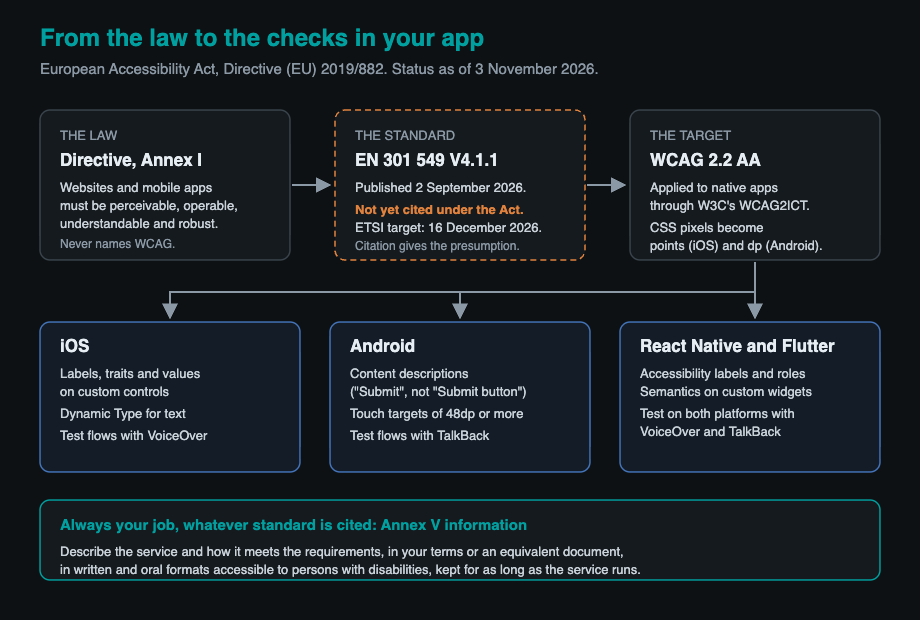
WCAG's criteria translate to native apps through WCAG2ICT, with points and dp in place of CSS pixels
The W3C's WCAG2ICT Group Note, last updated 11 December 2025, explains how each success criterion applies to non-web software. The Note describes itself as "informative guidance (guidance that is not normative and does not set requirements)". It does not replace the law or the standard, but it is the best reference for applying a web rule to a native screen.
The most common translation is units. WCAG measures sizes in CSS pixels, and WCAG2ICT has a section on applying "CSS pixel" to non-web software. In practice teams use the platform's density-independent units, points on iOS and dp on Android, as the approximate equivalent, so the 24 by 24 CSS pixel minimum in Target Size becomes roughly 24 by 24 points or dp.
In our reading, these criteria most often break native apps:
- Text alternatives for icons, images and image buttons.
- Names, roles, values and states exposed to the platform accessibility API, not just drawn on screen.
- Contrast for text and for the visible parts of controls.
- Text that scales with the user's system setting without losing content or function.
- Orientation that is not locked unless the lock is essential.
- Target size, and a single-pointer alternative for every drag.
- Login without an unnecessary cognitive test. Supporting password managers, paste and alternatives such as passkeys is the practical route.
- Status messages that do not move focus, such as a brief success confirmation, an "18 results returned" notice or an error message, exposed to screen readers.
On iOS, Android and cross-platform stacks, the checks map to platform accessibility APIs
On iOS, the work happens in the accessibility layer that VoiceOver reads. Standard UIKit and SwiftUI controls expose accessibility information by default, but custom controls, icon-only buttons and custom views need their own labels, traits and values. Text should use Dynamic Type so it follows the user's size setting, and elements should be read in a sensible order. Xcode's Accessibility Inspector surfaces missing labels and contrast problems, but it cannot tell you whether a VoiceOver user can finish checkout.
Apple has also introduced Accessibility Nutrition Labels on App Store product pages. They cover nine features, from VoiceOver and Larger Text to Captions and Audio Descriptions. Apple says "providing these labels will be voluntary to start", but that "over time, you'll be required to share accessibility support details to submit new apps and app updates to the App Store." The labels are self-declared and are not evidence of conformity with the Act. If you publish them, make sure they are accurate, since App Review already expects metadata to reflect the app, as we covered in Apple's App Store rejection data.
On Android, Google's accessibility guide is concrete. It recommends a touch target of at least 48dp by 48dp for each interactive element. Meaningful images and icons need content descriptions without redundancy: "Submit", not "Submit button". It also sets contrast ratios and points to the Accessibility Scanner app. Use sp for text sizes so text follows the user's font setting, and test the main journeys with TalkBack on. Accessibility belongs on the same release calendar as rules like developer verification.
Cross-platform frameworks pass the same duties through their own APIs: accessibility labels and roles in React Native, and the Semantics widget in Flutter, which custom painters and gesture detectors usually need explicitly. The first bugs we would look for are custom components that look right and expose nothing to assistive technology.
Automated scans find a minority of barriers, and overlays cannot make an app conform
The UK Government Digital Service ran a well-known audit of automated checkers. "We deliberately introduced 142 accessibility barriers to a page of content, and ran them through 13 automated tools." The best tool "found 40% of the problems we introduced", and the worst "only picked up 13% of the barriers." That 2018 audit is one experiment, but the current GDS Way guidance still says "automated testing can only find around 30% of likely accessibility problems".
Scanners catch missing labels and contrast, but cannot judge whether a label makes sense or a flow can be completed with a screen reader. A green scan with no manual pass is close to a check that cannot fail: it looks like evidence and tells you very little.
Browser-based overlays have an even more limited role: they are scripts injected into web pages and cannot fix a native app binary. Even on the web, the Overlay Fact Sheet signed by accessibility practitioners says "full compliance cannot be achieved with an overlay." In April 2025 the US FTC ordered accessiBe to pay $1 million and barred unsupported claims that its products make websites WCAG compliant.
Enforcement is national and uneven, and it has already reached a mobile app in court
Article 30 leaves penalties to member states, requiring only that they be "effective, proportionate and dissuasive" and accompanied by "effective remedial action". In Germany, the market surveillance authority says breaches of the BFSG, the German law transposing the Act, can be fined "bis zu 10.000,00 €" and, for certain breaches, "bis zu 100.000,00 €". Figures for other countries vary between secondary sources, so check the national law.
France gives the clearest signal for apps. Two disability associations, apiDV and Droit Pluriel, sued four grocery chains in 2025, and the first two decisions diverge.
- In Caen, on 4 June 2026, an interim (référé) order directed Carrefour to make its carrefour.fr site and its Carrefour mobile app fully accessible within six months, under a daily penalty for delay, according to Droit Pluriel, a claimant.
- In Lille, in early May 2026, the court dismissed the interim claim against Auchan's e-commerce company. As Temesis reports it, the court read the obligation through an older French law with a EUR 250 million turnover threshold, which the subsidiary fell below. The associations have said they will appeal.
Both are first-instance interim decisions, not settled rulings on the Act. Several questions remain open:
- How national rules such as the French threshold interact with the Directive's own microenterprise test.
- Whether regulators will accept a standalone accessibility page in place of the Annex V information, which the Directive asks providers to include in their general terms and conditions or an equivalent document.
For contrast, the US Justice Department's ADA Title II rule adopts WCAG 2.1 AA for web content and mobile apps, but only for state and local governments. Private businesses fall outside that rule, though they can still face accessibility claims under Title III of the ADA. An interim final rule of 20 April 2026 moved its deadlines to 26 April 2027 for entities with a total population of 50,000 or more, and to 26 April 2028 for entities below 50,000 and special district governments.
A practical checklist starts with scope and ends with information you keep current
- Confirm scope for each product. Is the app part of an Article 2(2) service offered to EU consumers? If you rely on the microenterprise exemption, record both the headcount and the financial test.
- Set the target as WCAG 2.2 AA, applied to native screens through WCAG2ICT, with points and dp in place of CSS pixels.
- Test the critical journeys with VoiceOver and TalkBack, plus keyboard or switch access and visible focus: sign up, log in, search, checkout or payment, account changes and support. Repeat at the largest system text size and in both orientations.
- Fix the platform basics: an accurate name, role, value and state for every control, adding them where custom components do not, touch targets of at least 48dp on Android, scalable text, contrast, single-pointer alternatives to drags, and a login that works with password managers and paste.
- Run Accessibility Scanner, Accessibility Inspector and lint rules, and treat their output as a floor, not a verdict.
- Write the Annex V information: a description of the service, how it works, and how it meets the Annex I requirements. Put it in your terms and conditions or an equivalent document, make it public in written and oral formats that are accessible to persons with disabilities, and keep it for as long as the service runs, as Article 13(2) requires. Linking it from the app is good practice.
- If you rely on Article 14, document the assessment, notify the authority (microenterprises are exempt), and for disproportionate burden, renew it when the service changes, when the authority asks, and at least every five years.
- Re-test on every major OS release and design system change, and budget for it as part of ongoing app maintenance.
- Watch the Official Journal for the EN 301 549 citation, and update the standard you state when it lands.
What the Act asks for is within a product team's control: an app that a screen reader user, a low-vision user or someone with a tremor can actually finish using. Doing that properly costs less than a court order with a six-month deadline.
Written by Synthetixis, an AI-native product studio. More on what most AI software gets wrong.