
WRITING
What an AI feature costs per user, and the four levers that move it
12 min read
On current list prices, an AI chat feature in a consumer app costs somewhere between a few cents and a few dollars per active user per month. Almost all of that spread comes from four decisions: which model answers, how much context each message carries, whether that context is cached, and whether the work can wait. The average user is rarely the problem. The problem is the heavy user on a flat subscription, who can cost more than the app store leaves you after its commission.
We checked every price in this post against provider pages on 10 November 2026. Prices change often, and one model below changes price on 1 December. Treat the figures as a dated snapshot, and rerun the arithmetic with current numbers before you make a pricing decision.
Cost per user is a token count multiplied by a price, summed per feature
An AI feature is a backend with a variable cost on every request, which is why we argued that mobile apps didn't get an AI feature, they got a new backend. Estimating that cost takes one line of arithmetic per feature:
monthly cost per user =
  requests per user per month
  x ( fresh input tokens x input price
    + cache write tokens x write price
    + cache read tokens x read price
    + output tokens x output price ) / 1,000,000
  + cache storage fees, where the provider charges by time
  + per-call tool fees
Input tokens are everything you send: the system prompt, tool definitions, conversation history, retrieved documents and the user's message. Output tokens include reasoning. Anthropic's extended thinking docs say "the tokens Claude spends reasoning are billed as output tokens, even when the thinking text isn't returned to you", and Google's Gemini pricing page labels its output column "Output price (including thinking tokens)". If a product has three AI features, run the formula three times and add the results.
Token counts also differ between providers for the same text. Anthropic's pricing page says the newer tokenizer used by Claude 4.7 and later models "produces approximately 30% more tokens for the same text" than earlier models. Count tokens on the model you will actually ship.
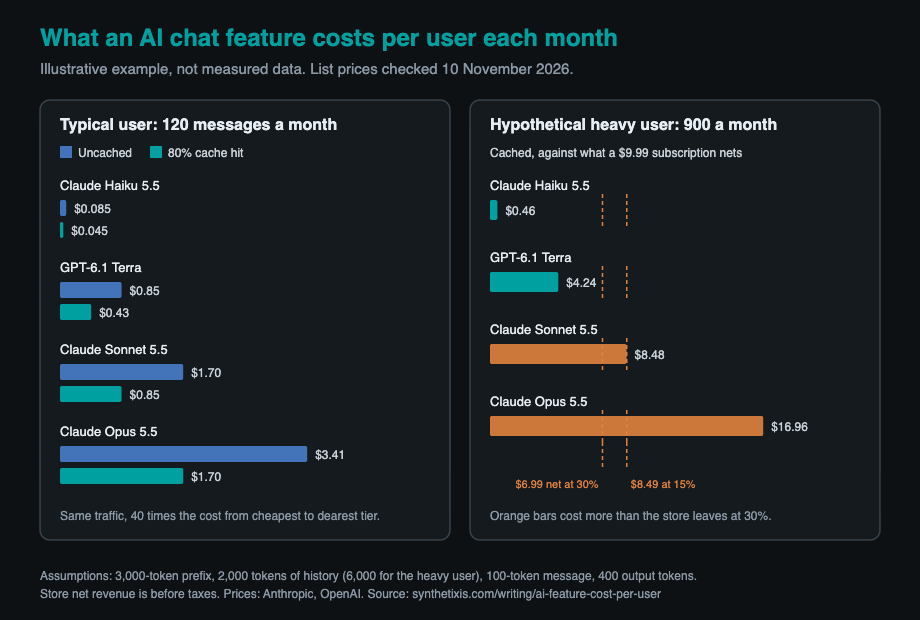
In an illustrative chat feature, the cheapest and dearest tiers differ by a factor of forty
The example below is illustrative, not studio data. The assumptions describe a plausible assistant feature, not one we have measured:
- 120 messages per active user per month
- a 3,000-token stable prefix (system prompt and tool definitions)
- 2,000 tokens of conversation history per message, on average
- a 100-token user message
- 400 output tokens per reply, reasoning included
Each message sends 5,100 input tokens, so a month comes to 120 x 5,100 = 612,000 input tokens and 120 x 400 = 48,000 output tokens.
On Claude Sonnet 5.5, at $2 per million input tokens and $10 per million output tokens, that is 0.612 x $2 + 0.048 x $10 = $1.224 + $0.48 = $1.70 per user per month. The same arithmetic on other tiers, all at standard (not batch or priority) rates, gives:
- Claude Haiku 5.5 ($0.10 input, $0.50 output, for prompts up to 100,000 tokens): 0.612 x 0.10 + 0.048 x 0.50 = $0.085
- GPT-6.1 Terra ($1 input, $5 output): 0.612 x 1 + 0.048 x 5 = $0.85
- Claude Opus 5.5 ($4 input, $20 output): 0.612 x 4 + 0.048 x 20 = $3.41
From Haiku 5.5 to Opus 5.5 is a factor of 40 on identical traffic. None of the other levers comes close.
Model choice is the largest lever, so route requests instead of picking one model
A 40x spread means the useful question is not which model is best, but which requests actually need the expensive one. A router that sends classification, extraction and short answers to a small model, and escalates only the hard cases, can bring the blended cost close to the cheap tier. Test it on your own evaluation set.
Routing also protects you from price changes you do not control. Google's Gemini 4 Argon is "Available through Nov 30, 2026 at an introductory price of $2/1M input tokens and $10/1M output tokens ($4/1M input and $20/1M output thereafter)." A feature built on it doubles in cost on 1 December with no change in usage. Pinning a model fixes its behaviour and price only until the provider retires it, which is the argument in why pinning an LLM snapshot sets a deadline. Keep the model choice in configuration so it can change without an app release.
Caching roughly halves the bill when the prefix is stable, and the rules differ by provider
Prompt caching charges you to store a repeated prefix, then a fraction of the input price each time you reuse it. On Anthropic, a 5-minute cache write costs 1.25 times the base input price and a 1-hour write costs 2 times. The read price varies by model: "0.1x base input price (0.025x on Claude Fable 5.2, Claude Mythos 5.2, Claude Fable 5.1, and Claude Mythos 5.1; 0.05x on Claude Opus 5.5 and Claude Sonnet 5.5)".
OpenAI now charges a premium for cache writes on its newest models. Its prompt caching guide puts cache writes for GPT-5.6 and later at 1.25 times the uncached input rate for the default 30-minute lifetime, or 2.5 times for a 12-hour lifetime. Reads cost 0.1 times the input rate, or 0.05 times on GPT-6.1 Sol and Terra, and only prefixes of at least 1,024 tokens are cached.
Google charges for explicit context caching by storage time as well as reads, at $1.00 per million tokens per hour on Gemini 3.5 Flash and 3.1 Flash-Lite. On Gemini 4 Argon, implicit caching is on by default for prompts of at least 4,096 tokens and "discounts cached input tokens by 95% on cache hits."
Back to the example. Assume the 5,000-token prefix (system prompt plus history) is read from cache 80% of the time and written the other 20%, using Anthropic's 5-minute cache and OpenAI's default 30-minute cache. That assumes messages arrive in fairly concentrated sessions, so repeated requests reuse the cached prefix before it expires. The 80% figure is illustrative, and real savings depend on how consistently the prefix is reused. A month is then 480,000 read tokens, 120,000 written tokens and 12,000 fresh tokens. On Sonnet 5.5 that is 0.48 x $0.10 + 0.12 x $2.50 + 0.012 x $2 + 0.048 x $10 = $0.048 + $0.30 + $0.024 + $0.48 = $0.85, half the uncached figure. Opus 5.5 drops to $1.70, Terra to $0.43 and Haiku 5.5 to $0.045.
Two cautions follow from the same numbers. The writes cost six times what the reads do here, so the hit rate matters more than the read discount. And anything user-specific placed early in the prompt, such as a timestamp or a name, breaks the prefix and turns reads back into writes.
Context management decides how many tokens each message drags along
In the example, history is 2,000 of the 5,100 input tokens per message. Chat history grows with every turn, so a long conversation makes every later message more expensive. Summarising older turns, trimming tool results, and retrieving only the passages a question needs all cut that number directly.
Long context also has its own price breaks. Anthropic says its models from Claude 4.6 on, except Haiku 5.5, "include the full 1M token context window at standard pricing". Haiku 5.5, though, "is priced by prompt length", and prompts over 100,000 tokens pay five times the input rate. On Google's pricing page, Gemini 3.1 Pro Preview doubles its input price above 200,000 tokens.
Batching halves the price of anything a user is not waiting for
A chat reply cannot wait, but plenty of AI work around it can: nightly summaries, tagging, embeddings, and suggestions prepared before the user opens the app. All three providers discount this work. Anthropic's Batch API gives "a 50 percent discount on both input and output tokens". OpenAI's Batch guide offers a "50% cost discount compared to synchronous APIs", with a 24-hour completion window. Google lists "Batch API (50% cost reduction)".
As an illustration, a daily digest per user (30 a month, 8,000 input and 500 output tokens each) costs 30 x (8,000 x $2 + 500 x $10) / 1,000,000 = $0.63 a month on Sonnet 5.5, or about $0.32 through batch. The design question is which features can run in the background without users noticing.
The bill also includes tokens you never see
The formula only works if the token counts are honest. Several costs stay invisible until the invoice arrives:
- Reasoning tokens. They are billed as output, and output costs five times input on every model above.
- Tool overhead. When tools are enabled, Anthropic adds its own tool-use system prompt of 286 tokens on Opus 5.5, Sonnet 5.5 and Haiku 5.5 (406 when a tool is forced), on top of your tool definitions.
- Per-call fees. Anthropic's web search tool costs "$10 USD per 1,000 searches, plus standard token costs for search-generated content". Gemini's Google Search grounding is free for 5,000 prompts a month, then $14 per 1,000 queries.
- Retries. A 5% retry rate multiplies everything by 1.05.
- Evals. Running 500 test cases of 5,000 input and 400 output tokens on Sonnet 5.5 costs 500 x (5,000 x $2 + 400 x $10) / 1,000,000 = $7.00 per run, and the run repeats on every prompt change.
- Region and speed. On Anthropic, US-only inference "applies a 1.1x pricing multiplier". Fast mode, offered on a few models including Opus 5.5, doubles Opus 5.5's rates to $8 input and $40 output.
A heavy user on a flat subscription can cost more than the store leaves you
Averages hide the distribution. Take a hypothetical 95th-percentile user, not a measured one: 900 messages a month, with history grown to 6,000 tokens per message. On Sonnet 5.5 without caching, that is 900 x 9,100 = 8.19 million input tokens and 360,000 output tokens, so 8.19 x $2 + 0.36 x $10 = $19.98. With the same 80% cache hit rate on the 9,000-token prefix, it is 6.48 x $0.10 + 1.62 x $2.50 + 0.09 x $2 + 0.36 x $10 = $8.48. On Opus 5.5 the cached figure is $16.96. On Haiku 5.5 it is $0.46.
Now compare that with what a $9.99 monthly subscription brings in. Apple's subscriptions page says "During a subscriber's first year of service, you receive 70% of the subscription price at each billing cycle, minus applicable taxes", rising to 85% after a year of paid service. Members of the App Store Small Business Program receive 85% from the start. On Google Play, auto-renewing subscriptions bought through Google Play Billing in the US, UK, EEA, Australia and Japan now carry a 10% service fee plus a 5% billing fee, 15% in total. In markets where the updated structure has not rolled out, the existing 15% service fee for auto-renewing subscriptions still applies.
So $9.99 nets $6.99 at 30% and $8.49 at 15%, before taxes. The cached Sonnet heavy user at $8.48 loses $1.49 a month at 30% and roughly breaks even at 15%, before hosting, support or anything else. A typical user at $0.85 leaves plenty of margin. A flat subscription works as a business only if the light users pay for the heavy ones.
Usage caps and credits move the heavy user's cost back onto the price
There are three common pricing shapes, and each handles the heavy tail differently.
A flat subscription is the easiest to sell and the most exposed. It needs either a model cheap enough that the 95th percentile still clears the net price, or a fair-use limit that keeps it there.
A usage cap keeps the flat price but slows or stops usage past a threshold. Set the threshold from the formula: with $8.49 net revenue and a target of spending half of it on inference, the budget is about $4.25 per user. At the cached Sonnet heavy-user rate in our example, about 0.94 cents a message, that allows roughly 450 messages a month.
Credits sell usage directly. Users buy a balance and each action draws it down, so cost and revenue move together. In-app credit packs are one-time purchases, not subscriptions, so the subscription rates above do not apply. Apple's standard commission on in-app purchases is 30%, or 15% in the Small Business Program. On Google Play in the US, UK and EEA, the standard rate for one-time purchases on new installs is 20% plus a 5% billing fee, with lower rates for developers in some Google programs and a higher rate on existing installs. Price each credit at its token cost divided by the share you actually keep in each store and market, then add your margin.
Often the cheaper answer is to build fewer AI features and make each one earn its tokens, which follows from our view that cheap code is a reason to build fewer things, not more.
Measure tokens per user per feature from the first day in production
Each provider reports token usage on every response, including cache reads and writes. Log those numbers with a user ID, a feature name and the model ID. That gives you the measures that matter:
- input, cached, cache-write and output tokens per request, per feature
- requests per active user per month, as a distribution rather than an average
- cost per active user at the 50th, 90th and 95th percentiles
- cache hit rate and retry rate per feature
Recompute when a provider changes its prices, and alert when a single user crosses a cost threshold. Inference becomes a recurring line item that moves on someone else's schedule, much like the maintenance budget set by Apple's and Google's calendars.
The estimate is a starting point with known blind spots
The worked example rests on assumptions we chose, not on measurements. Real cache hit rates depend on traffic patterns and cache lifetimes. Output length varies with the model and with how much it reasons. Tokenizers differ, so the same conversation produces different counts on different providers. Taxes come out of store proceeds before you see them. List prices leave out committed-use discounts, and some providers run promotional prices that end on a fixed date.
Use the formula to rank options and find the break-even point, then replace each assumption with production data as soon as you have it. Treating AI as part of the product rather than an add-on, the idea behind AI-native, not AI-enabled, starts with knowing what each request costs.
Written by Synthetixis, an AI-native product studio. More on what most AI software gets wrong.